Table games at online casinos offer some of the best value in the whole lobby, and Canadian players who know the numbers can make an evening’s budget go much further. The gap between the cheapest and the most expensive bets is huge, often larger than the gap between one casino and another.
Every figure below comes from published house edge tables. Checking the numbers before the fun starts is also the habit behind www.canada-gambling.com, which describes itself as calm and numbers-first and promises to say plainly when something is bad for players, a refreshing approach for anyone tired of hype.
The Numbers Side by Side
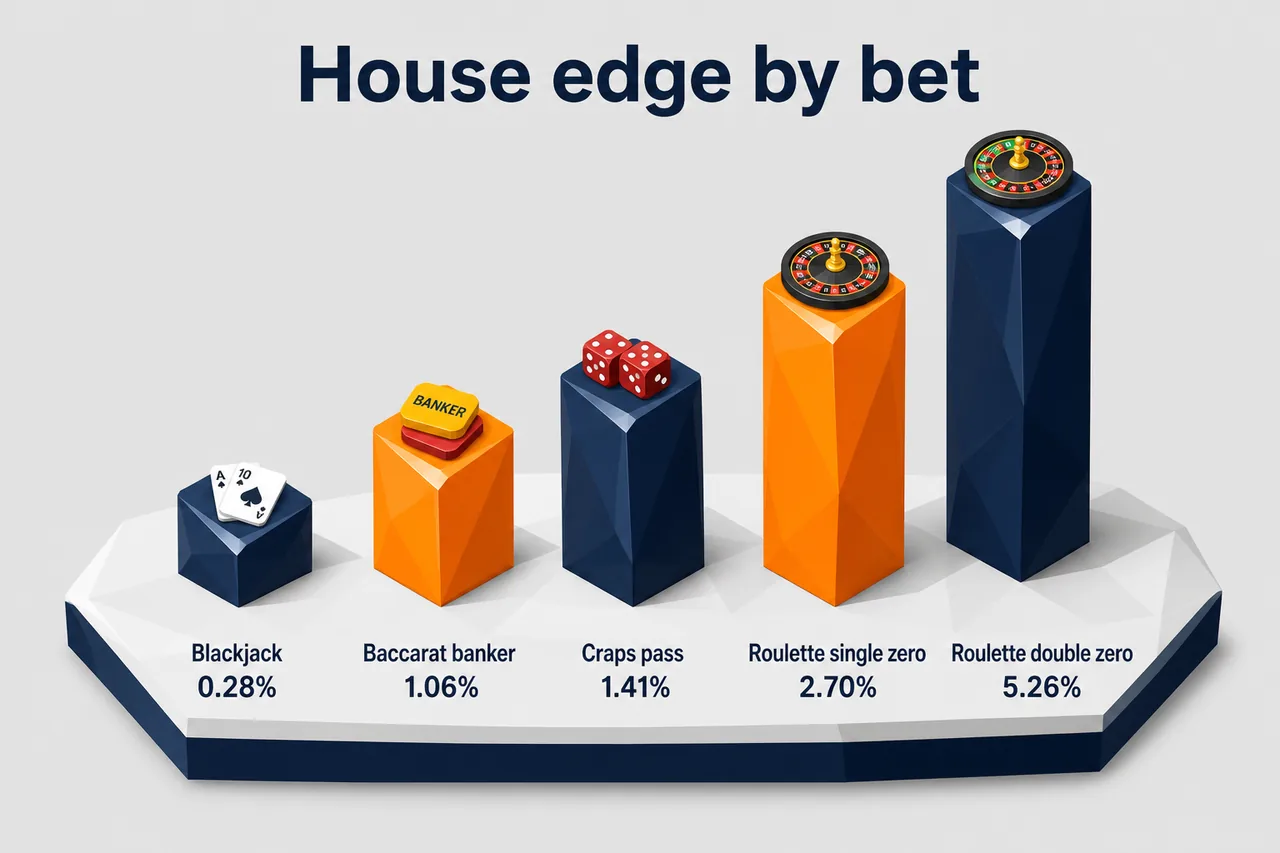
This summary lists the most popular table bets from the lowest edge to the highest. The figures assume good or optimal play where a choice exists.
| Game and bet | House edge | Note |
|---|---|---|
| Blackjack, liberal rules | 0.28% | Needs basic strategy and good rules |
| Baccarat, banker | 1.06% | Commission is built into the figure |
| Baccarat, player | 1.24% | No commission |
| Craps, don’t pass | 1.36% | Where craps is offered |
| Craps, pass line | 1.41% | The classic starting bet |
| Roulette, single zero | 2.70% | European style wheel |
| Three Card Poker, ante and play | 3.37% | Before side bets |
| Roulette, double zero | 5.26% | American style wheel |
The spread runs from well under one percent to more than five. On the same budget, that difference can decide whether a session lasts all evening or ends within the hour.
What House Edge Really Measures
House edge is the average loss expressed as a share of the original bet. A 2.70% edge means that, over a very large number of bets, the casino keeps about 2.70 cents of every dollar you put on the table.
It is a long-run figure, not a promise about any one night. Each bet is independent of the last, as the Responsible Gambling Council reminds players, so short sessions swing widely in both directions.
Why Optimal Play Matters
Published figures usually assume that you make the best available decision whenever the game gives you a choice. In blackjack, that means following basic strategy. In games without choices, such as baccarat or roulette, the edge depends only on which bet you pick.
Note. If you play blackjack on instinct rather than strategy, your real edge will be higher than the published figure. The low number is earned, not given.
Blackjack Rewards Players Who Learn the Basics
Blackjack can be the cheapest table game in the lobby, but only at the right table and with the right decisions. The 0.28% figure assumes a generous rule set and basic strategy.
Rules That Keep the Edge Low
The rule set behind that low figure is specific. Look for these features in the table details.
- The dealer stands on soft 17.
- You can double down on any two cards.
- You can double after splitting a pair.
- You can resplit aces.
- Late surrender is allowed.
Rules That Push It Up
Some tables quietly change the deal. A blackjack that pays 6 to 5 instead of 3 to 2 takes a noticeably bigger cut from every natural. A dealer who hits soft 17, more decks in the shoe and limits on doubling all add to the edge as well.
Tip. Check the blackjack payout before anything else. If the table says 6 to 5, move on, because no amount of good play makes up for that rule.
Basic Strategy in Plain Terms
Basic strategy is a chart of the best decision for every combination of your hand and the dealer’s visible card. It does not guarantee wins. It simply removes the guesswork that otherwise gives away value on every hand, and many players keep a chart open beside the game.
Baccarat Is the Simplest Low-Edge Choice
Baccarat asks almost nothing of the player. You choose banker, player or tie, and the cards are dealt by fixed rules. That simplicity makes it one of the friendliest games for anyone who wants a low edge without learning a strategy chart.
Betting on the banker costs about 1.06% per bet, a figure that already includes the commission charged on banker wins. The player side sits at 1.24% with no commission. Both are excellent value by casino standards.
Why the Banker Side Pays Commission
Under the fixed drawing rules, the banker hand wins slightly more often than the player hand. Without a commission, the banker bet would favour the player, so casinos take a small cut of banker wins to restore their edge. That is why the two main bets end up so close together in cost.
Warning. The tie bet looks tempting because it pays well, but its edge is about 14.36%. That is more than ten times the cost of the banker bet, so most experienced players leave it alone.
Tables vary, and the published figures only hold when the standard terms apply. Before you sit, open the rules panel and confirm these points.
- The commission charged on banker wins.
- The payout offered on a tie.
- Any side bets on the layout and their payouts.
- The minimum and maximum bet per round.
Roulette Depends on the Wheel You Choose
Roulette is a game of pure chance, so the only decision that changes your cost is the wheel itself. A single-zero wheel has 37 pockets and an edge of 2.70%. A double-zero wheel adds a 38th pocket and nearly doubles the edge to 5.26%.
- Look at the wheel and count the green pockets before you bet.
- Check the table name or rules for “European” or “single zero”.
- Look for La Partage, a rule that returns part of an even-money bet when the ball lands on zero.
- Pick a stake that lets you enjoy many spins rather than a few big ones.
Why Every Bet Costs the Same
The maths behind the single-zero figure is simple. A straight bet on one number pays 35 to 1, but there are 37 pockets, so the fair payout would be 36 to 1. That missing unit works out to about 2.7% of every stake.
Every standard bet on a given wheel carries much the same edge, so red, black, a single number or a corner all cost about the same over time. The wheel matters far more than the bet.
Craps Has Some of the Best Bets in the House
Craps is less common online, but where it appears it offers real value on its main bets. The pass line carries an edge of about 1.41%, and the don’t pass bet sits slightly lower at 1.36%.
The game looks complicated because of its crowded layout. In practice, a player who sticks to the pass or don’t pass line can enjoy craps at a cost similar to baccarat.
Good to know. Many of the other bets on a craps layout carry far higher edges than the line bets. Read the paytable before you spread chips around the centre of the table.
Poker-Style Table Games and Casino War
Several table games borrow the look of poker without the other players. Three Card Poker, played with the ante and play bets, carries an edge of about 3.37%. Let it Ride sits at about 3.51%.
Casino war is even simpler. If you go to war on ties, the edge is about 2.88%, and if you surrender on ties it rises to 3.70%. These games are fun and fast, but they cost more than blackjack, baccarat or the craps line bets.
Tip. Speed matters as much as the edge here. A quick game with a moderate edge can cost more per hour than a slow game with a higher one, so watch how many rounds you play.
Video Poker Sits Close to the Best Table Bets
Video poker usually lives in its own corner of the lobby, but it belongs in any conversation about value. A full-pay Jacks or Better machine, played with the best possible holds, carries an edge of only about 0.46%.
The catch is the same as in blackjack. That figure needs both a generous paytable and correct decisions on every hand. A machine with reduced payouts for a full house or a flush costs noticeably more, so the paytable is worth a careful look.
Good to know. Video poker plays much faster than a live table. A low edge applied to hundreds of hands an hour can still add up, so a time limit matters here too.
Side Bets and Wheel Games Cost the Most
The most expensive bets in a casino are often the most eye-catching ones. Big payouts and bright graphics hide edges that are many times higher than the main game.
| Bet | House edge |
|---|---|
| Baccarat tie | 14.36% |
| Casino war, bet on the tie | 18.65% |
| Big Six money wheel | About 11.11% to 24.07%, depending on the spot |
| Keno | About 25% to 29% |
Game-show style live titles, with their spinning wheels and multipliers, can also carry a much higher edge than classic table games. They are entertainment first, and their price reflects it.
Turning Edges Into Dollars
Percentages feel abstract until you put a budget next to them. The expected cost of any session equals the total amount you bet multiplied by the house edge.
The table below uses an illustrative C$2,000 in total bets over a month. That total might come from 200 bets of C$10. The results are averages, not forecasts.
| Game and bet | House edge | Expected cost on C$2,000 wagered |
|---|---|---|
| Blackjack, liberal rules, basic strategy | 0.28% | About C$5.60 |
| Baccarat, banker | 1.06% | About C$21.20 |
| Roulette, single zero | 2.70% | About C$54 |
| Roulette, double zero | 5.26% | About C$105.20 |
| Big Six, lowest-edge spot | 11.11% | About C$222.20 |
Same money, same number of bets, and a forty-fold difference in average cost between the top and bottom rows. That is why game choice is the single biggest lever a table player controls.
Cost Per Hour From a Canadian Casino’s Own Chart
Manitoba Liquor and Lotteries prints a GameSense pamphlet that turns the same idea into an hourly figure. Its formula is bet size times bets per hour times house advantage. The answer, in the pamphlet’s words, is “the average amount you will spend (lose) per hour over time”.
| Game and bet | Bet | Bets per hour | House advantage | Cost per hour |
|---|---|---|---|---|
| Baccarat, bank | $10 | 25 | 1.06% | $2.65 |
| Baccarat, player | $10 | 25 | 1.24% | $3.10 |
| Roulette, most bets | $5 | 26 | 2.71% | $3.52 |
| Let It Ride, regular bet | $5 | 40 | 3.51% | $7.02 |
| Baccarat, tie | $10 | 25 | 14.36% | About $36 |
Blackjack Depends on the Version
The pamphlet’s blackjack rows tell their own story. House advantages run from 0.51% on a double-deck game to 5.90% on another version, so the rules behind the name matter more than the name.
Note. These figures describe Manitoba’s land-based tables. Online games often deal faster, so the same formula with more bets per hour gives a higher hourly cost.
How Table Limits Shape the Night
Every table shows a minimum and a maximum bet per round. Those two numbers decide how many bets your budget can buy, which in turn decides how long the evening lasts.
Live tables often have higher minimums than software tables, because each seat needs a real dealer and studio time. A C$25 minimum might suit a large budget, but it can swallow a small one in a handful of hands.
Example. With an illustrative C$100 budget, a C$1 minimum table offers a hundred bets, while a C$25 table offers four. The edge is the same, but the first night lasts far longer and gives the averages a chance to work.
Live or Software, the Edge Stays the Same
Many sites offer both live dealer tables and software versions of the same games. The table rules decide the edge in both cases, not the stream. A banker bet at 1.06% costs the same per bet whether a real dealer turns the cards or software does.
The difference is pace. Live tables deal fewer rounds per hour, so the same edge costs less per hour of entertainment. Software tables move as fast as you click, which can multiply the hourly cost without you noticing.
Streaks and Systems at the Table
Table games invite pattern-spotting. A run of reds, a long banker streak or a cold blackjack shoe all feel like information. They are not. Each round is independent, so the next result does not care what came before.
- A long streak does not make the opposite result more likely.
- Changing tables after a loss does not reset your luck.
- Raising stakes to recover losses only increases the amount exposed to the edge.
- Scorecards and history boards are for entertainment, not prediction.
Online Casino Table Games for Beginners
If you are new to table games, start where the decisions are few. Baccarat is the gentlest introduction, since you only pick a side and the cards do the rest. Single-zero roulette is another easy start, as long as you confirm the wheel.
Once you feel comfortable, blackjack is the natural next step. Keep a basic strategy chart beside the game for the first few sessions, and play at the lowest limits until the decisions feel automatic. The learning time is short, and the reward is one of the lowest edges in the casino.
Build a Session Around Low-Edge Bets
A little planning turns these numbers into a better night. The steps are simple and take only a few minutes.
- Choose one main game with a low edge, such as blackjack with good rules or baccarat on banker.
- Read the table rules and confirm the payouts you expect.
- Set a session budget and a time limit in your account before you join.
- Pick a stake that gives you at least fifty bets from your budget.
- Skip side bets unless you have decided in advance to treat one as a small extra cost.
Canada’s lower-risk gambling guidelines also suggest sticking to no more than two types of games on a regular basis. A player who chooses one or two low-edge games and stays with them is following that advice almost by default.
Use These Games If, Skip Them If
Low-Edge Table Games Suit You If
- You want your budget to last a whole evening.
- You are happy to read the rules panel before every new table.
- You enjoy steady play more than the chance of a sudden big win.
- You are willing to learn basic strategy for blackjack.
Skip Them or Take Care If
- You find yourself drawn to tie bets and side bets for the big numbers.
- Fast software tables tempt you to play hundreds of rounds an hour.
- You are trying to win back losses rather than enjoy the game.
Low-edge games are a genuine benefit for Canadian players, because they turn the same budget into more hours of play. The edge never disappears, though, and every session can still end in a loss. Online tables are open to adults only, from 18 in Alberta, Manitoba and Quebec and from 19 in the other provinces.
If the fun ever fades and stress takes its place, the national 988 line takes calls and texts around the clock and connects you with a trained responder.