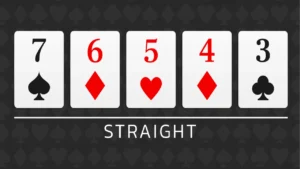
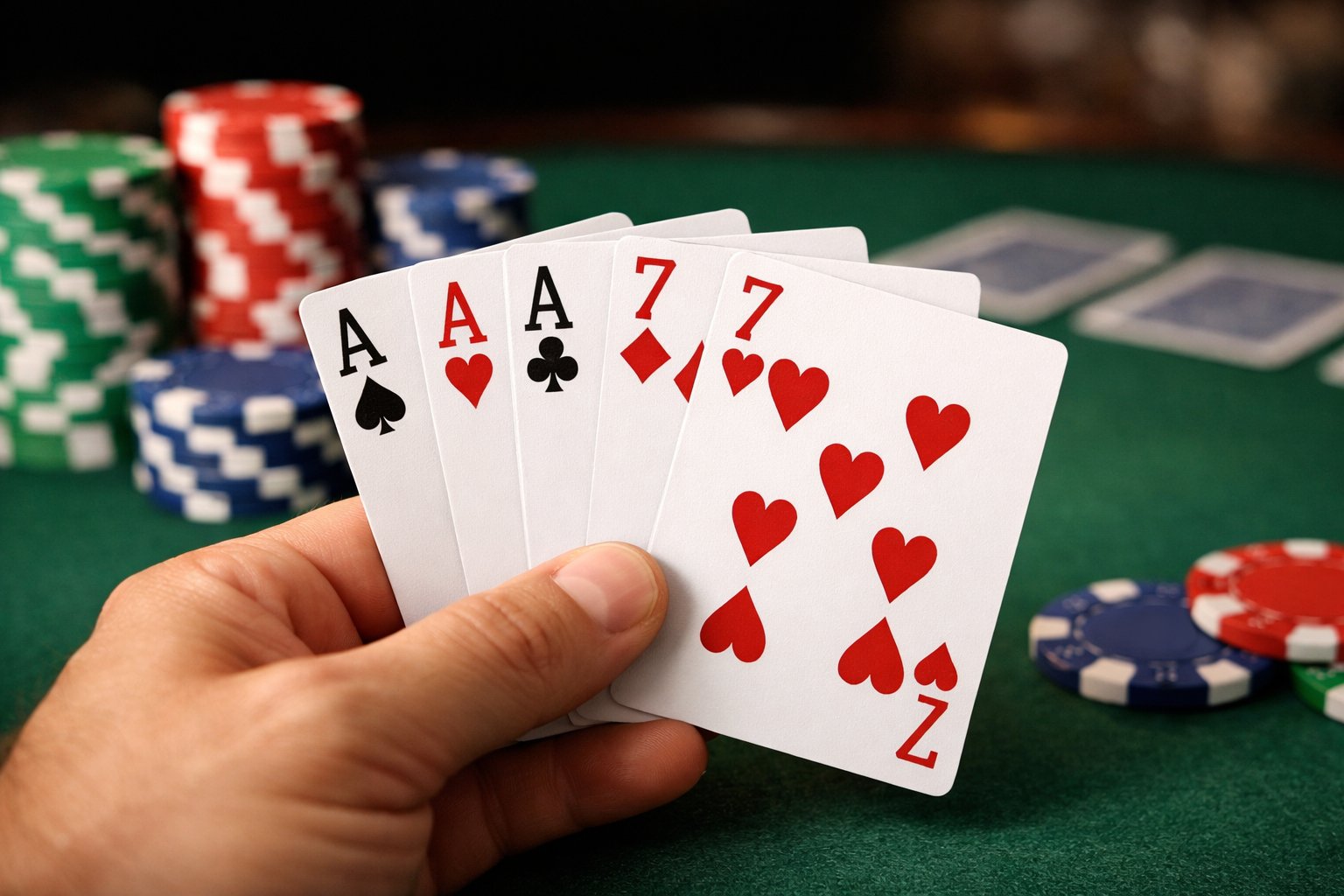
A full house is one of the strongest hands you can get in poker. It contains three cards of the same rank plus two cards of another rank, like three kings and two queens. This hand ranks fourth in the standard poker hand rankings, which means it beats most other hands you’ll see at the table.
When you make a full house, you’re in a strong position to win the pot. It loses only to four of a kind, a straight flush, and a royal flush. Understanding how to play this hand well can make a big difference in your results.
This guide will show you how a full house works, when it beats other hands, and how to play it the right way. You’ll learn the odds of making this hand and the best strategies to use when you have one.
Understanding a Full House in Poker
A full house combines three matching cards of one rank with a pair of another rank. This hand ranks as the fourth-strongest possible holding in standard poker games.
Definition of a Full House
A full house consists of exactly five cards: three cards of one rank and two cards of another rank. You need both parts to make this hand valid.
The three matching cards are called “trips” or a “three of a kind.” The pair completes the combination. You might hear players say “sevens full of threes” or “aces full of kings” to describe their full house. The first rank mentioned is always the three-card set.
All four suits can appear in your full house since you’re using five cards total. For example, you could hold three jacks (spades, hearts, diamonds) and two fours (clubs, spades). The suits don’t affect the hand’s strength.
How a Full House Is Ranked
A full house ranks above a flush and a straight but below four of a kind. Only three hands can beat you when you hold a full house: four of a kind, a straight flush, and a royal flush.
When two players both have a full house, the three-card set determines the winner. A full house with three kings beats a full house with three queens, regardless of what pairs each player holds.
If both players have the same three-card rank, the pair becomes the tiebreaker. Three nines with a pair of aces beats three nines with a pair of kings. This situation typically only occurs in games with community cards like Texas Hold’em.
Full House Hand Examples
Here are common full house combinations you might see:
Strong Full Houses:
- A♠ A♥ A♦ K♣ K♠ (aces full of kings)
- K♣ K♦ K♥ Q♠ Q♣ (kings full of queens)
- Q♠ Q♥ Q♦ J♣ J♠ (queens full of jacks)
Medium Full Houses:
- 9♣ 9♦ 9♥ 8♠ 8♣ (nines full of eights)
- 7♠ 7♥ 7♦ 6♣ 6♠ (sevens full of sixes)
Lower Full Houses:
- 4♣ 4♦ 4♥ 3♠ 3♣ (fours full of threes)
- 2♠ 2♥ 2♦ A♣ A♠ (twos full of aces)
Even the weakest full house beats any flush or straight. The last example shows how three twos with two aces still creates a powerful hand despite using low cards for the trips portion.
Full House in Poker Strategy and Probability
A full house appears in roughly 2.6% of random seven-card poker hands, making it strong but not extremely rare. Playing this hand correctly requires understanding when to bet aggressively and when other players might hold stronger combinations.
How Often a Full House Occurs
The probability of getting a full house depends on the stage of the game and your starting cards. In Texas Hold’em, if you flop a set (three of a kind), you have about a 33% chance to improve to a full house or better by the river.
The exact odds vary by situation. When you see all seven cards in a standard game, you’ll make a full house approximately once every 38 hands. This frequency makes it valuable but not guaranteed.
Your odds improve significantly when you start with a pocket pair. If you hold two matching cards and see the same rank on the flop, you already have trips and multiple chances to fill your full house on the turn or river.
Best Practices for Playing a Full House
You should almost always bet aggressively when you make a full house. This hand loses only to four of a kind or a straight flush, which are extremely rare.
Key strategic moves include:
- Bet for value – Extract maximum chips from opponents holding flushes or straights
- Control pot size – Build the pot on earlier streets when you have a set
- Watch the board – Note if a higher full house is possible based on community cards
- Avoid slowplaying – Don’t give free cards that could beat you
Pay attention to how the board develops. If you hold 8-8 and the board shows 8-K-K-3-2, your full house (eights full of kings) beats most hands but loses to anyone holding a king.
Full House vs. Other Poker Hands
A full house ranks fourth in standard poker hand rankings. It beats flushes, straights, three of a kind, two pair, one pair, and high card hands.
Hands that beat a full house:
- Royal flush – A-K-Q-J-10 of the same suit
- Straight flush – Five consecutive cards of the same suit
- Four of a kind – Four cards of the same rank
When two players both have full houses, the one with the higher three-of-a-kind wins. For example, Q-Q-Q-4-4 beats J-J-J-A-A because queens rank higher than jacks. If both players have the same three of a kind, the higher pair determines the winner.