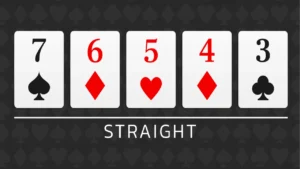
A straight in poker can make or break your hand, but many players don’t fully understand how it works or when to play it aggressively. A straight is a poker hand made up of five cards in consecutive rank order, regardless of their suits. For example, if you hold 5-6-7-8-9, you have a straight even if the cards are different suits.
This hand ranks as the fifth-best hand in poker, which means it beats pairs, two pairs, and three of a kind, but loses to flushes, full houses, and stronger combinations. You’ll see straights appear regularly at the table, making them important to recognize and play correctly.
Knowing when your straight is strong enough to bet and when you should be careful can help you win more pots and lose less money. The cards you hold, your position at the table, and how your opponents are betting all affect whether your straight will win the hand.
Understanding a Straight in Poker
A straight consists of five consecutive cards that can be of any suit. This hand ranks in the middle of poker hand rankings, beating hands like three of a kind and two pair but losing to flushes and full houses.
Definition of a Straight
A straight is a poker hand made up of five cards in sequential order. The suits of these cards don’t matter at all.
For example, you can have a straight with cards from different suits like hearts, diamonds, clubs, and spades mixed together. The only rule is that the card values must follow in consecutive order.
The ace can work in two different ways when you make a straight. It can count as the lowest card in a five-high straight (A-2-3-4-5), or it can count as the highest card in a ten-high straight (10-J-Q-K-A). However, you cannot wrap around the corner, meaning K-A-2-3-4 is not a valid straight.
When two players both have straights, the player with the highest top card wins. If both straights have the same high card, the pot is split equally between the players.
Ranking of a Straight Versus Other Hands
A straight sits right in the middle of the poker hand rankings. You’ll beat several common hands but lose to some stronger ones.
Hands a straight beats:
- Three of a kind
- Two pair
- One pair
- High card
Hands that beat a straight:
- Royal flush
- Straight flush
- Four of a kind
- Full house
- Flush
The flush is particularly important to remember because it’s the hand that ranks directly above a straight. Many new players incorrectly think a straight beats a flush, but this is not true. The flush is harder to make, which is why it ranks higher.
Examples of a Straight
Here are clear examples of valid straights you might see in a poker game:
Valid Straights:
- 5♠ 6♥ 7♣ 8♦ 9♠ (nine-high straight)
- 10♣ J♦ Q♥ K♠ A♣ (ace-high straight, also called Broadway)
- A♦ 2♠ 3♥ 4♣ 5♦ (five-high straight, also called a wheel)
- 3♥ 4♥ 5♥ 6♥ 7♥ (seven-high straight, which is also a straight flush)
The ace-high straight is the best possible straight you can make. The five-high straight is the lowest possible straight.
If you have 9♠ 10♦ J♣ Q♥ K♠, you hold a king-high straight. This would lose to an ace-high straight but would beat any lower straight like one that ends with a queen or jack.
Common Mistakes When Identifying Straights
New players often make errors when trying to identify whether they have a straight. The most common mistake is thinking that four cards in a row count as a straight. You need exactly five consecutive cards, not four.
Another frequent error is trying to wrap the ace around from king to two. Remember that K-A-2-3-4 does not form a valid straight. The ace works at either end of the sequence but not in the middle as a connector between king and two.
Some players also confuse straights with flushes. A straight requires five cards in order regardless of suit. A flush requires five cards of the same suit regardless of order.
Players sometimes count cards incorrectly when community cards are involved. Make sure you’re using exactly five cards total to form your straight, and that all five cards are in perfect sequential order with no gaps.
Strategic Considerations for Straights
A straight requires careful calculation and smart decision-making to maximize profits while minimizing losses. Understanding the math behind completing straights and knowing when to pursue draws separates winning players from losing ones.
Odds of Hitting a Straight
When you hold four cards to a straight, you have either an open-ended straight draw or a gutshot straight draw. An open-ended straight draw gives you eight cards that complete your hand, while a gutshot only gives you four outs.
With an open-ended straight draw on the flop, you have approximately 31.5% chance of hitting your straight by the river. On the turn alone, your odds are about 17%. These odds mean you need proper pot odds to justify calling bets.
A gutshot straight draw cuts your chances in half. You only have roughly 16.5% chance to complete your straight by the river and about 8.5% on the turn. These weaker odds require larger pots or smaller bets to make calling profitable.
Playing Strategies With a Straight
When you make a straight, you need to extract value without scaring opponents away. Betting too aggressively might fold out weaker hands that would pay you off. Betting too cautiously could allow free cards that complete stronger hands like flushes.
Consider the board texture carefully. A straight on a paired board risks losing to a full house. A straight on a three-flush board could already be beaten by a flush or might lose when the fourth suited card arrives.
Your position matters significantly when playing straights. In late position, you can control pot size and respond to opponent actions. In early position, you might need to check-raise to build the pot or protect your hand from draws.
Straight Draws and Their Types
Open-ended straight draws connect on both ends. If you hold 8-9 and the flop shows 6-7-K, any 5 or 10 completes your straight. This draw type offers the best odds and most flexibility.
Gutshot straight draws need one specific rank in the middle. Holding 8-9 on a 6-Q-K flop means only a 7 completes your hand. These draws are weaker and typically require better pot odds or implied odds to pursue.
Double gutshot straight draws provide eight outs like open-enders but through two different inside ranks. These occur less frequently but offer similar strength to open-ended draws when they appear.